Traditional Educational and Action Research
Traditional educational research has a long history of conducting research for a specific topic and releasing it into the public knowledge-base. The systematic approach to this kind of research could be done as scientific-based inquiry that uses guided principles toward the question being asked or the hypothesis being tested. It could pertain to the relevant theory, what methods are being used to seek answers to the research question, what reasoning is applied, what results will be generated, and how they will be disclosed (McMillian & Schumacher, 2010, pp. 6-7). Whereas, action research is more concerned with how to effectively create change in a single classroom, or possibly a school, or district, rather than doing a generalized large study. And, Action Research can be used outside of education, in such organizations as corporations, governments, philanthropies, and even the military.
Traditional educational research
This research generally seeks to answer a question, or tests a hypothesis, and the researchers generally are not a part of the study itself, so can be very objective about their findings. There are certain steps that are taken to arrive at a conclusion. Educational research consists of:
1) problem selection;
2) finding literature to review on problem;
3) formulating a research question, or hypothesis;
4) select a design and methodology & decide where and from whom data will be collected;
5) how will the data be collected and analyzed;
6) analyzed data shown as results;
7) conclusive interpretation of results and/or summary of the problem (McMillan & Schumacher, 2001, pp. 13-14).
This general research is to increase the knowledge-base on a given subject.
This research generally seeks to answer a question, or tests a hypothesis, and the researchers generally are not a part of the study itself, so can be very objective about their findings. There are certain steps that are taken to arrive at a conclusion. Educational research consists of:
1) problem selection;
2) finding literature to review on problem;
3) formulating a research question, or hypothesis;
4) select a design and methodology & decide where and from whom data will be collected;
5) how will the data be collected and analyzed;
6) analyzed data shown as results;
7) conclusive interpretation of results and/or summary of the problem (McMillan & Schumacher, 2001, pp. 13-14).
This general research is to increase the knowledge-base on a given subject.
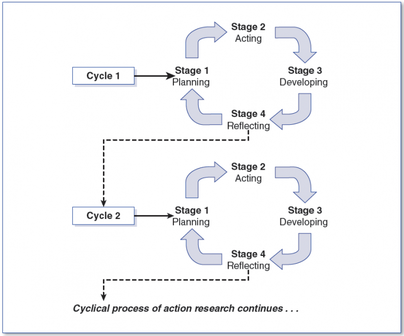
Action research is defined as "Any systematic inquiry conducted by teachers, administrators, counselors, or others with a vested interest in teaching and learning process or environment for the purpose of gathering information about how their particular schools operate, how they teach, and how their students learn" (Mills, 2011, Mertler, 2017, p. 3). It may approach research from an educational or from an organizational standpoint. The process to conduct Action Research involves four stages which are:
1) the planning stage;
2) the acting stage;
3) the developing stage;
4) the reflecting stage (Mertler, 2017, p. 36). This is a cyclic process for continuous improvement.
And, the stages are incorporated into the nine steps used to conduct action research--they are:
1) identifying and then limiting the topic;
2) gathering information;
3) reviewing the associated literature;
4) developing a research plan;
5) implementing the plan and data collection;
6) analyzing the data collected;
7) developing an Action Plan itself;
8) sharing and communicating the results;
9) reflecting on the results (Mertler, 2017, p. 36).
1) the planning stage;
2) the acting stage;
3) the developing stage;
4) the reflecting stage (Mertler, 2017, p. 36). This is a cyclic process for continuous improvement.
And, the stages are incorporated into the nine steps used to conduct action research--they are:
1) identifying and then limiting the topic;
2) gathering information;
3) reviewing the associated literature;
4) developing a research plan;
5) implementing the plan and data collection;
6) analyzing the data collected;
7) developing an Action Plan itself;
8) sharing and communicating the results;
9) reflecting on the results (Mertler, 2017, p. 36).
http://www.lindenwood.edu/files/resources/large_mertler-figure-1.png
Action research is most often focused on a classroom, school, or district. Much of this action research may be done locally, to help at a specific school. "More important, action research is characterized as research that is done by teachers for themselves" (Mertler, 2014, p. 3). The outcome may create a better teaching and/or learning environment for both the instructors and the learners. If successful, then this information may be implemented in other districts, counties and so forth, as the need arises. The action research process is systematic in nature and can be scientific in the way it is executed, and may also be applied to other fields outside of education.
According to Mertler (2017) "Quantitative research methodologies require the collection of numerical data and utilize a deductive approach to reasoning; they include both nonexperimental (e.g., descriptive, correlational, causal-comparative research) and experimental designs. (Whereas,) Qualitative research methodologies require the collection of narrative data and utilize an inductive approach to reasoning; they include phenomenology, ethnography, grounded theory, and case studies" (p. 31).
Quantitative researchers use deductive reasoning and collect numerical data. These researchers may use opinion/rating scale surveys that could be done by mail, via the computer, or on-location to collect data. They may also, or alternately, choose to do experiments where they have control over an independent variable that they choose to manipulate on a treatment group, and not on a control group, to measure the effect on an independent variable. Correlational is considered to be non-experimental study which illustrates the relationship among any number of variables used within that study, or studies. Quasi-experimental study is very similar to true experimental, yet no random selection of participants is involved.
Qualitative research studies may include: Ethnography; Phenomenology; Case Study; and Critical Studies where an inductive approach to reasoning is used. Ethnography deals with people in social groups, often focusing on their cultural interactions through interviews or observations. Phenomenological studies try to make sense and explain a phenomenon or lived experience. Case studies involve the deep study of individual program activities, groups, or persons. Critical Studies may be used to reveal inequities that the researcher may wish to expose or make right (McMillan, 2010, pp. 23-24, 485-489).
Mixed methods of research may be incorporated in studies. The researchers may use both quantitative and qualitative methods to reach a clearer understanding of the results, of not only what happened, but also why.
Triangulation is defined as: the "process of relating multiple sources of data in order to establish their trustworthiness, or verification of the consistency of the facts while trying to account for their inherent biases" (Bogdan & Biklen, 2007; Glesne, 2006; Mertler, 2017, p. 11). "'triangulation'...it simply means that there is more than one source of data--perhaps, a more appropriate term would be 'polyangulation'..." (Mertler, 2017, p. 11). "Triangulation design is a mixed method design in which quantitative and qualitative data are collected at the same time" (McMillan, 2010, p. 491). The reason to use multiple sources in any study is to seek clarification from different perspectives.
Reflection on the research classes that I took:
EDUC 607 was taken first, and dealt more with traditional research in education. Our instructor had us concentrate on implementation and methodology. Attached are two papers--the first on implementation, the second on methodology. I learned the importance of these areas of research, but due to time restrictions by our teacher, I did not execute my implementation plans on any participants.
ETEC 543 introduced me to Action Research. In class, there were discussions on the difference between these two types of research, that are commonly utilized in education. I did a team project in this ETEC 543 class, following the Action research steps. My final project paper is attached as a sample.
Another difference between the two classes was that ETEC 543 had us do in-depth studying of the Institutional Review Board (IRB). I attached my IRB certificate of completion, which may help me in my future with other research projects. In our 543 final research project, we created an Informed Consent form that is attached below. When we sent it to the college IRB, they finally decided we would not need it for testing on human subjects, but only because we could assure them that no student names would be used, and that the research paper would only be used in 543, and not published. But, going through the process of creating it was a positive experience, and made us more aware of the application of the CITI IRB training applications where it could be mandated in future research projects, especially when we may wish to publish and share our results widely.
EDUC 607 was taken first, and dealt more with traditional research in education. Our instructor had us concentrate on implementation and methodology. Attached are two papers--the first on implementation, the second on methodology. I learned the importance of these areas of research, but due to time restrictions by our teacher, I did not execute my implementation plans on any participants.
ETEC 543 introduced me to Action Research. In class, there were discussions on the difference between these two types of research, that are commonly utilized in education. I did a team project in this ETEC 543 class, following the Action research steps. My final project paper is attached as a sample.
Another difference between the two classes was that ETEC 543 had us do in-depth studying of the Institutional Review Board (IRB). I attached my IRB certificate of completion, which may help me in my future with other research projects. In our 543 final research project, we created an Informed Consent form that is attached below. When we sent it to the college IRB, they finally decided we would not need it for testing on human subjects, but only because we could assure them that no student names would be used, and that the research paper would only be used in 543, and not published. But, going through the process of creating it was a positive experience, and made us more aware of the application of the CITI IRB training applications where it could be mandated in future research projects, especially when we may wish to publish and share our results widely.
References:
McMillan, J. H. and Schumacher, S. (2001), Research in education: A Conceptual Introduction. 5th ed. New York: Longman
McMillan, J.H. and Schumacher, S. (2010). Research in education: Evidence-based inquiry. 7th ed. Boston, Mass.: Pearson Education.
Mertler, C. (2017). Action research: Improving schools and empowering educators (5th ed.,). Thousand Oaks, California: SAGE Publications pp. 1-338.
Image from:
http://www.lindenwood.edu/files/resources/large_mertler-figure-1.png
McMillan, J. H. and Schumacher, S. (2001), Research in education: A Conceptual Introduction. 5th ed. New York: Longman
McMillan, J.H. and Schumacher, S. (2010). Research in education: Evidence-based inquiry. 7th ed. Boston, Mass.: Pearson Education.
Mertler, C. (2017). Action research: Improving schools and empowering educators (5th ed.,). Thousand Oaks, California: SAGE Publications pp. 1-338.
Image from:
http://www.lindenwood.edu/files/resources/large_mertler-figure-1.png

| 607_implementation_paper_v5.docx |
| 607_methodology_v4.docx |
| 543_final_project_report_v9.docx |

| 543 appendices_a-g for v9 report above.zip |

| citi completion report4444238__2_.pdf |
| informed_consent_form_v2.pdf |
